Posts

Vedantic significance in Ramayanam - 1. Swami Chinmayananda
Image
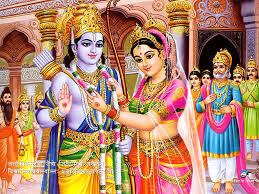
16/11/2018 1. In Ayodhya, ( yudhdha means conflict, Ayodhya means where there is no conflict ) to the king Dasharatha ( = one who has conquered all the ten indriyaas ) was born the Supreme Lord, Sri Rama (= 'That One' who is revelling in every form - ' sarve ramanti yasmin iti Ramaah ' ) as a baby. Rama grows up in Ayodhya (without any conflicts ) and then goes out of Ayodhya with sage Vishwamitra to protect the yajnas Rama gets married to Sita. Janaka is her father. Janaka found her while ploughing the mother earth, most improbable place to come out from. Ultimately, she goes back to mother earth. So here is someone who came from no-cause and goes back to no-cause, and this is called, in vedaanta, as ' Maaya '. Thus Rama, the Atman, the Self, gets wedded to Maaya.Once ' Self ' gets wedded to Maya, the Ego, ' I ' can not remain in Ayodhya. Conflict must necessarily start. Thus he goes to jungle with Sita. Jungle means the forest ...

RAMAYANAM : A TEXT BOOK FOR HUMANITY - 4.

Image
02/11/2018. SYNOPSIS OF THE SEVEN KANDAS In Sundara-Kanda Hanuman's exploits are described. During his aerial journey, Mainaka, an island peak, invites Hanuman to rest on its top at the request of the ocean. Afterwards, Simhika, a monstress living in the ocean, drags him down by catching his shadow. Hanuman kills her. Then he gets a distant view of Lanka and enters the city at night. He finds out Sita in the Asoka grove. He gives her Rama's token and message. Hanuman destroys the Asoka grove. The Rakshasas imprison Hanuman. Hanuman frees himself and sets fire to Lanka. He returns back to the place where Rama is staying and gives Sita's gem to Rama. Rama is highly delighted when he receives Sita's token and her message. In Yuddha-Kanda, Nala (one of the monkey-chiefs) builds a bridge across the ocean by the advice of the ocean. The heroes with a large army of monkeys cross the ocean and reach Lanka. Vibhishana (brother of Ravana) joins them and tel...

RAMAYANAM : A TEXT BOOK FOR HUMANITY -3.

Image
12/10/2018. 3. SYNOPSIS OF THE SEVEN KANDAS In Bala-Kanda the Incarnation of Sri Rama and his childhood life are described. Rama helps Visvamitra by guarding his sacrifice. He slays ogress Tataka and Subahu. He frees Ahalya from her curse. He breaks the bow of Siva and marries Janaki and annihilates the pride of Parasurama. In Ayodhya-Kanda preparations are made for installing Rama as heir-apparent. His step-mother Kaikeyi stands in the way and sends him in exile for fourteen years. Rama's brother Lakshmana and wife Sita follow him. Raja Dasaratha (father) becomes very much afflicted at heart on account of his separation from Rama and dies due to grief. Rama, Lakshmana, and Sita are entertained by Guha, a hunter-chief. They cross the Ganga and meet Rishi Bharadvaja. They go to Chitrakuta on the advice of the Rishi. They build a cottage made up of grass and leaves (Parna Kutir) there. Then Bharata (another devoted brother) goes to the forest and insists Rama to return to...

RAMAYANAM : A TEXT BOOK FOR HUMANITY -2.

Image
23/09/2018 2. Then Brahma himself, the Creator of the world, appeared before the poet and said, "Sing Rama's charming story in the same melodious metre. As long as this world endures, as long as the stars shine in heaven, so long shall thy song spread among men". So saying Brahma vanished. He inspired the poet with the knowledge of Sri Rama's whole story; whereupon Valmiki sat down in meditation and saw every event in Sri Rama's story in detail in his Yogic vision. Then he began to write the Ramayana. The melody of Ramayana was born from a heart of love and pity for the wounded bird. When applied to Ramayana, the verse of Valmiki sung out of pity for the Krauncha, can be interpreted thus: Sri Rama and Sita represent the two Kraunchas. Ravana represents the cruel hunter. Sita was cruelly separated from Rama by the cruel hunter Ravana. There is a slight similarity in these cases. The hunter's cruel act was a forerunner to Valmiki's inspiration to na...

RAMAYANAM : A TEXT BOOK FOR HUMANITY -1.

Image
30/08/2018 1. INTRODUCTION :- The Ramayana of Valmiki is perhaps the most ancient and glorious epic in the world. It is known as the Adikavyam,—the first poem. Ramayana exercises a great moulding power on the life of man. It contains object lessons for husbands and wives, parents and children, brothers and sisters, friends and enemies. ITS ORIGIN : - Valmiki once asked Narada, "O Venerable Rishi! Please tell me whether there is a perfect man in this world who is at once virtuous, brave, dutiful, truthful, noble, steadfast in duty, and kind to all beings". Narada replied, "There is such a one, a prince of Ikshvaku's line named Rama. He is virtuous, brave, gentle, and wise. He is a great hero. He loves his subjects immensely. He is a protector of Dharma. He is firm and steadfast. He is just and liberal. He is well-versed in the Vedas and in the science of arms. He is unique in the possession of virtues and matchless in beauty. He is an obedien...

BEAUTIES OF RAMAYANAM : 3.3.'3,4,5,6.'

Image
08/08/2018 3. INTRODUCTION OF MAIN CHARACTERS : 3.3.'3,4,5,6'. 3. DASARATHA Dasaratha literally means one who has restrained or controlled his ten organs or one who has the ten organs under control. It is the Jiva proper and so we find Dasaratha being addressed as Jiva in Ramayana. This Dasaratha or Jiva is always very anxious to get out of this ocean of Samsara. But for Dasaratha (Jiva personified), it was in no case possible to do so, unless he realised Brahman or the Self who is no other than Rama. The Jiva has to become one with the Self and as such Dasaratha, the Jiva, had to do proper Sadhana or penance for putting under full restraint all his ten Indriyas or organs, to make it one with the Self. Dasaratha ruled over this body, the city of ten organs or gates for full 1100 years. It is only after controlling the organs and becoming one with the Self, that Dasaratha, the Jiva, is in a position to get the Divine vision—Divya Chakshu or Jnana, the eternal light or i...

BEAUTIES OF RAMAYANAM : 3.3.2

Image
25/07/2018 3. INTRODUCTION OF MAIN CHARACTERS : 3.3.2 3.HANUMAN :- 2. When the wind god saw that Hanuman was struck by Indra, he ceased to blow. The people of the three worlds became frightened by this. The gods tried to please the wind god. Brahma said, "Your son Hanuman will not be destroyed by arms, on account of my blessing." Indra was struck with astonishment when he saw that Hanuman survived, even though he was struck by thunder. He blessed Hanuman and said, "The son of the wind god will die only at his will, on account of my blessing." Hanumanji is undoubtedly the greatest military genius that the world has ever produced. He raised a huge army counting over 30 lakhs of soldiers and espousing the cause of Rama, led his vast armies with no military equipment, except what was turned out from stumps and boughs of trees and stones, to fight the great battle with the mighty King of Ceylon. This intrepid warrior was the greatest military engineer and i...